How to choose
Feeder, camera or tracker: which smart pet device to buy first
Each device answers one question and no device answers two. Match the problem you actually have to the hardware, before the monthly fee decides for you.
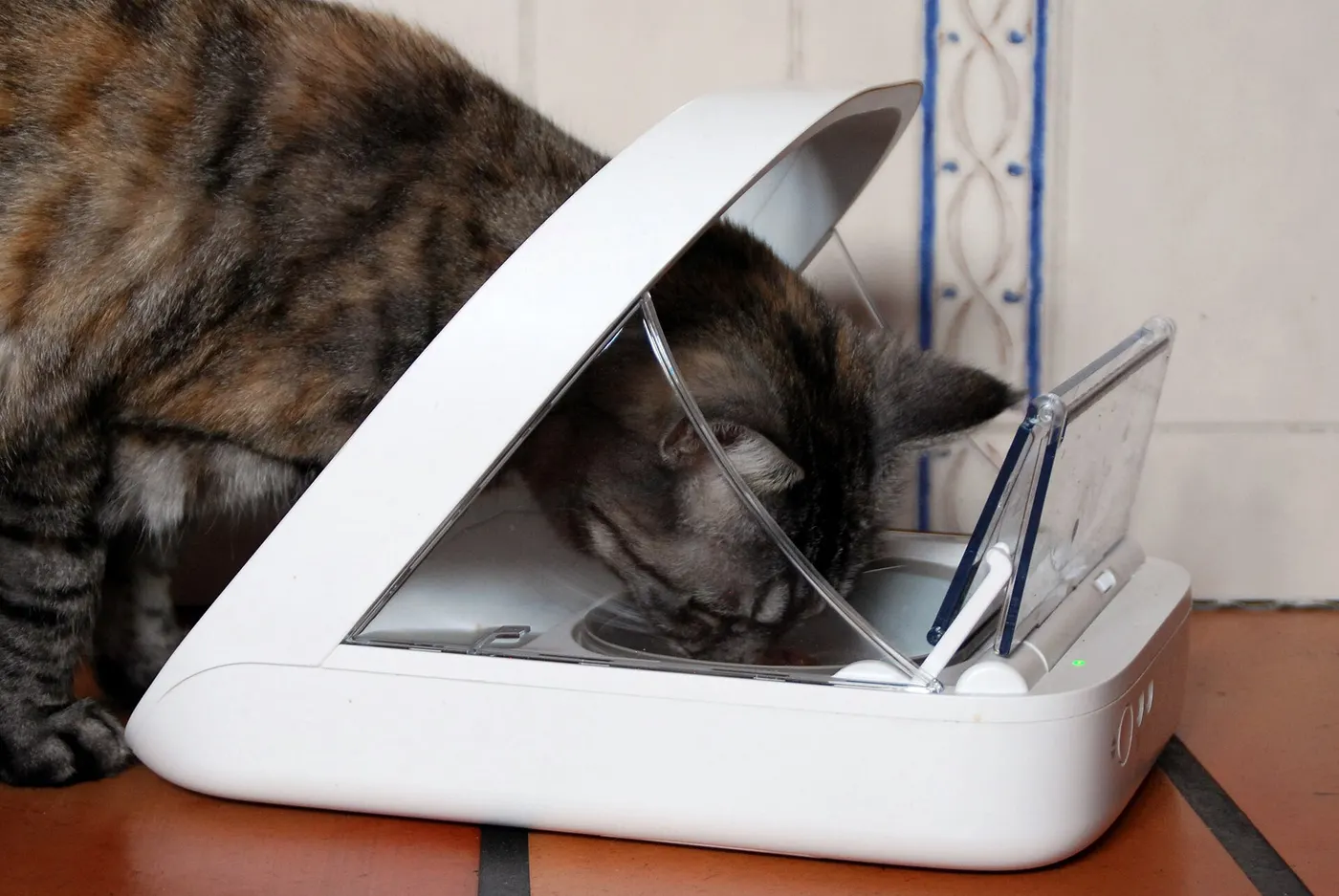
Smart pet devices are sold as a category and used as single-purpose tools. A feeder cannot tell you why the bowl is still full, a camera stops at the door, and a tracker reports where the animal is rather than how it got there. Choosing well is mostly a matter of naming the problem precisely enough that only one of them fits.
This guide matches problems to devices, sets out the specifications that actually constrain the choice, and shows where the recurring fees sit. Every price below is an example used to make the arithmetic visible; this site has tested no devices, sells nothing and publishes no live prices.
Name the problem before the category
Most regretted purchases in this category are the right device for somebody else's problem. A household where meals slip by two hours on busy evenings needs a timer with a hopper. A household where one cat eats the other's prescription food needs a feeder that reads a microchip, which is a different and more expensive machine. The two are shelved together.
The same split runs through the rest of the category. A camera answers what happens in one room while you are out; it does not answer where the animal went after it left through the fence. A tracker answers that and nothing about behaviour indoors. Buying both to cover both questions is a legitimate decision, and the budget guide on this site puts that pair at $286 a year once the fees are counted.
Write the problem as a sentence with a time in it. The meals are 2 hours late on Tuesdays. The dog barks for 40 minutes after we leave. The cat got out twice last year. A sentence in that form usually selects the device by itself, and it is also the only way to know later whether the purchase worked.
| The problem | The device | What it does not fix |
|---|---|---|
| Meals are late or doubled when the household is busy | Scheduled feeder with a hopper | It cannot tell you why the bowl is still full |
| Two animals, one bowl, different diets | Microchip or RFID feeder | It will not change what either animal wants to eat |
| You do not know what happens while you are out | Indoor camera | It stops at the door |
| The animal gets out of the garden | GPS tracker collar | It reports where, not how it got out |
| Water is forgotten or goes stale | Circulating fountain | It adds a filter to the yearly budget |
Each row is one problem. A household with three of these problems is buying three devices, not one device with three modes.
The specifications that actually constrain the choice
For a feeder, the number that matters is how many days the hopper covers. A hopper quoted at 6 L holds roughly 2.5 kg of a typical dry kibble, and at 150 g a day that is about 16 days between refills, or roughly 22 refills a year. Halve the hopper and you double the refills, which is the difference between a device that helps and a chore that beeps.
For a tracker, the number is battery life in days, and the quoted figure always assumes a reporting interval. A tracker quoted at 6 days reporting once an hour is doing six times as much radio work if you set it to report every 10 minutes, and the days fall accordingly. Read the interval next to the battery claim or the claim means nothing.
For a camera, the number is what survives without the subscription. Live view, local recording to a memory card and cloud history are three separate features, and some devices lose two of the three when a plan lapses. Under the Competition Act a performance claim about a product must be based on an adequate and proper test, which is a reasonable filter for any battery or range figure quoted without conditions.
- Feeder: hopper volume converted into days, not litres. A 6 L hopper at 150 g a day is about 16 days
- Feeder: a stated weight or size limit for the animal, which appears on the device rather than in the listing
- Tracker: battery life in days stated alongside the reporting interval it assumes
- Tracker: whether the collar attachment is breakaway, which changes what happens if it snags
- Camera: which of live view, local recording and cloud history survive a cancelled plan
Weight and size limits are written on the device
Almost every physical pet device carries a stated limit for the animal that uses it, and those limits are set by the mechanism rather than by convention. A microchip feeder's lid opens to a fixed aperture, a pet door has a maximum shoulder height, and a tracker collar has a minimum neck size below which it simply will not sit still enough to read.
The figures appear in the manual rather than the headline, which is why so many of these devices are returned. Check them against the animal you have, measured this month, rather than against a breed average. A dog on a weight-management diet crosses a stated limit in both directions over a year.
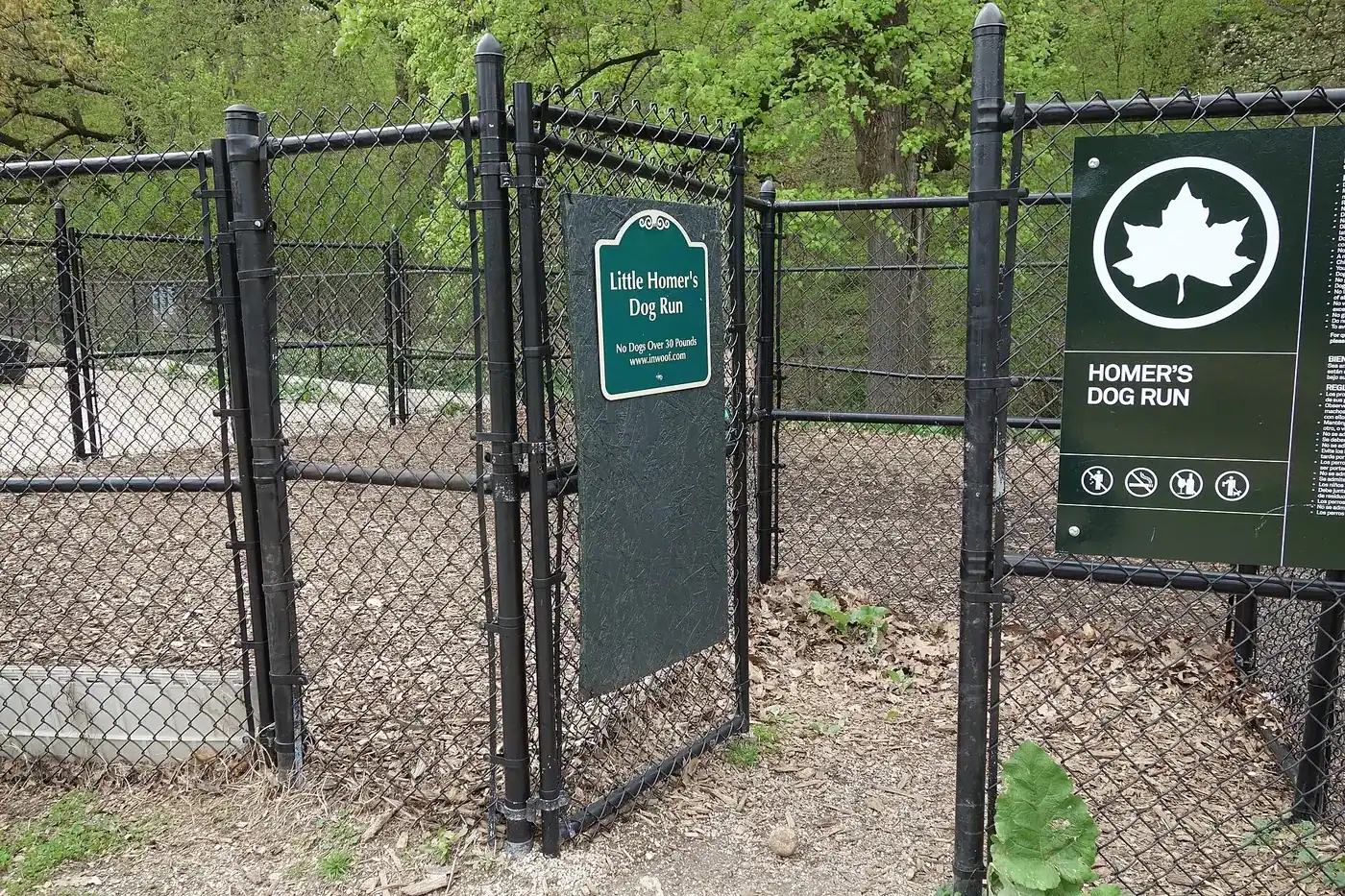
The same applies to shared spaces. Fenced dog runs often post their own limits, and signs reading no dogs over 30 pounds are common at smaller enclosures. A device sized for your animal is not automatically a device your animal can use everywhere you take it.
| Device | Measurement to take | Why it decides the purchase |
|---|---|---|
| Microchip feeder | Weight, and shoulder width at the bowl | The lid aperture is fixed and the animal has to fit through it |
| Pet door | Shoulder height and chest width | A door sized by weight alone traps wide, short animals |
| Tracker collar | Neck circumference and the animal's weight | Below the minimum neck size the unit slides and reports badly |
| Fountain | Daily water intake in millilitres | Reservoir size converts into days between refills |
Measure this month rather than using a breed average, and re-measure after any change of diet.
The fee is part of the specification
A tracker that needs a cellular plan and a camera that needs cloud storage are both subscription products with hardware attached. On the example figures used across this site, a tracker at $90 plus $8 a month comes to $126 a year, and a camera at $80 plus $12 a month comes to $160 a year, against a feeder at $160 with no plan at all, which is $46 a year including backup batteries.
That ordering is the opposite of the shelf prices. The cheapest device on the shelf is the dearest to own, because the fee is paid 12 times a year and the hardware is paid once. Across a three-device household the fees are $240 of a $332 yearly total, which is about 72%.
Canadian law requires the advertised price to be reachable. The Competition Bureau treats promoting a price that is not attainable because of fixed obligatory charges as a false or misleading representation, with an exception only for charges imposed by an Act of Parliament or a legislature, such as sales tax. If the device does not function at all without a plan, the plan belongs in the advertised price.
| Device | Example shelf price | Recurring cost | Cost per year |
|---|---|---|---|
| GPS tracker collar | $90 | $8 a month cellular plan | $126 |
| Indoor camera | $80 | $12 a month cloud plan | $160 |
| Microchip feeder | $160 | $14 a year of backup batteries | $46 |
| Circulating fountain | $70 | $36 a year of filters | $53.50 |
Yearly cost spreads the hardware over 3 years for the tracker, 5 for the camera and feeder and 4 for the fountain, then adds the recurring line. Full workings are in the budget guide on this site.
What to check before you pay
Search the model name in the Government of Canada's recalls and safety alerts database, which held 19,875 active alerts and 14,449 archived alerts when this guide was checked. It covers consumer products as well as food, health products and vehicles, and it is the fastest way to find out whether a device has a history before you own one.
Then read what happens in a power cut, because that is the failure mode that matters for anything holding food or water. A feeder with no battery backup misses the meal it was bought to deliver, and the safety guide on this site covers the test for it, which takes about 5 minutes with the plug pulled.
Finally, decide what the device does with its own account deleted. The Office of the Privacy Commissioner of Canada advises buyers to establish what personal information a connected device collects, whether it is shared, how long it is kept and whether it can be deleted, all before the purchase. A camera in a living room is a camera in your living room for as long as the recordings exist.
Before you buy
- Write the problem as a sentence containing a time, before looking at any product
- Convert hopper or reservoir size into days at your animal's actual daily intake
- Read the battery life claim together with the reporting interval it assumes
- Measure your animal this month and check it against the device's stated limits
- List every monthly fee and multiply by 12 before comparing shelf prices
- Search the model in the Government of Canada recalls and safety alerts database
- Find out what the device still does with the subscription cancelled
Questions readers ask
- Which device should I buy first if I can only buy one?
- The one that matches a problem you can write down with a time in it. If meals slip, the feeder, because it is also the only one of the three with no monthly fee at $46 a year on the example figures. If the animal gets out, the tracker, because no camera will find a dog two streets away. Cameras answer curiosity more often than they answer a problem.
- How many days should a feeder hopper cover?
- Long enough that refilling is weekly rather than daily. A hopper quoted at 6 L holds roughly 2.5 kg of typical dry kibble, which at 150 g a day is about 16 days, or roughly 22 refills a year. A 2 L hopper on the same diet is about 5 days and 73 refills a year, which is more often than most people will keep up.
- Are microchip feeders worth the extra over a plain timer?
- Only if more than one animal shares the space. The aperture that reads the chip and opens for one animal is the whole mechanism, and it costs roughly double a plain timed feeder at the example prices. In a single-animal household it buys nothing a timer does not, and it adds a lid the animal has to learn to use.
- Does a tracker work everywhere in Canada?
- It works where its cellular network does, which is not the same as where your phone works, because trackers often use a low-power network band. The honest test is to check coverage for the specific network the tracker uses in the places you actually walk, including the cottage. In the bush, a tracker is often reporting its last known position rather than its current one.
- What happens to a camera when the subscription lapses?
- It varies by product, which is exactly why it belongs on the shortlist as a specification. Three features are at stake: live view, recording to a local memory card, and cloud history. Some devices keep the first two and lose the third; others show nothing at all. Write the answer next to the price before comparing two cameras, because $12 a month is $144 a year.
Sources
- Government of Canada — Recalls and safety alerts database — checked 2026-11-03
- Competition Bureau Canada — Drip pricing and unattainable prices — checked 2026-11-03
- Competition Bureau Canada — Misleading representations and deceptive marketing practices — checked 2026-11-03
- Office of the Privacy Commissioner of Canada — Smart devices and your privacy — checked 2026-11-03
Some links on this site can earn us a commission. That does not change which product a guide recommends, and it adds nothing to your price. Advertising is not enabled on this site yet. When it is, ads will be labelled and kept visually separate from the guides.